
In-admin readiness scanner (eleven checks), agent traffic estimates, clear issue findings and recommended next steps — for merchants who want to understand current agentic-readiness gaps before upgrading.
Run the public scan →Magento module · Agentic Commerce Suite
Whose store does the AI assistant recommend?
Shoppers already ask ChatGPT where to buy. This Magento module measures your store's share of those recommendations — with the winning competitors named — and installs the merchant feeds, structured data and agent endpoints that make your catalog one an assistant can actually read and transact with. Diagnostics are free, inside your own admin; the infrastructure is Pro.
Demo login demo / agentic-demo-2026 — a real Magento 2.4.8 with the module installed and licensed. You land on its dashboard, populated with a genuine share-of-voice run. Nothing to install, no form to fill in.
Every visibility figure the module produces is a sampled estimate from non-deterministic assistant answers, run on your own OpenAI API key. We never promise placement, ranking or citation in any AI surface — measurement and infrastructure are what you buy.
Inside the admin
This is the whole product.
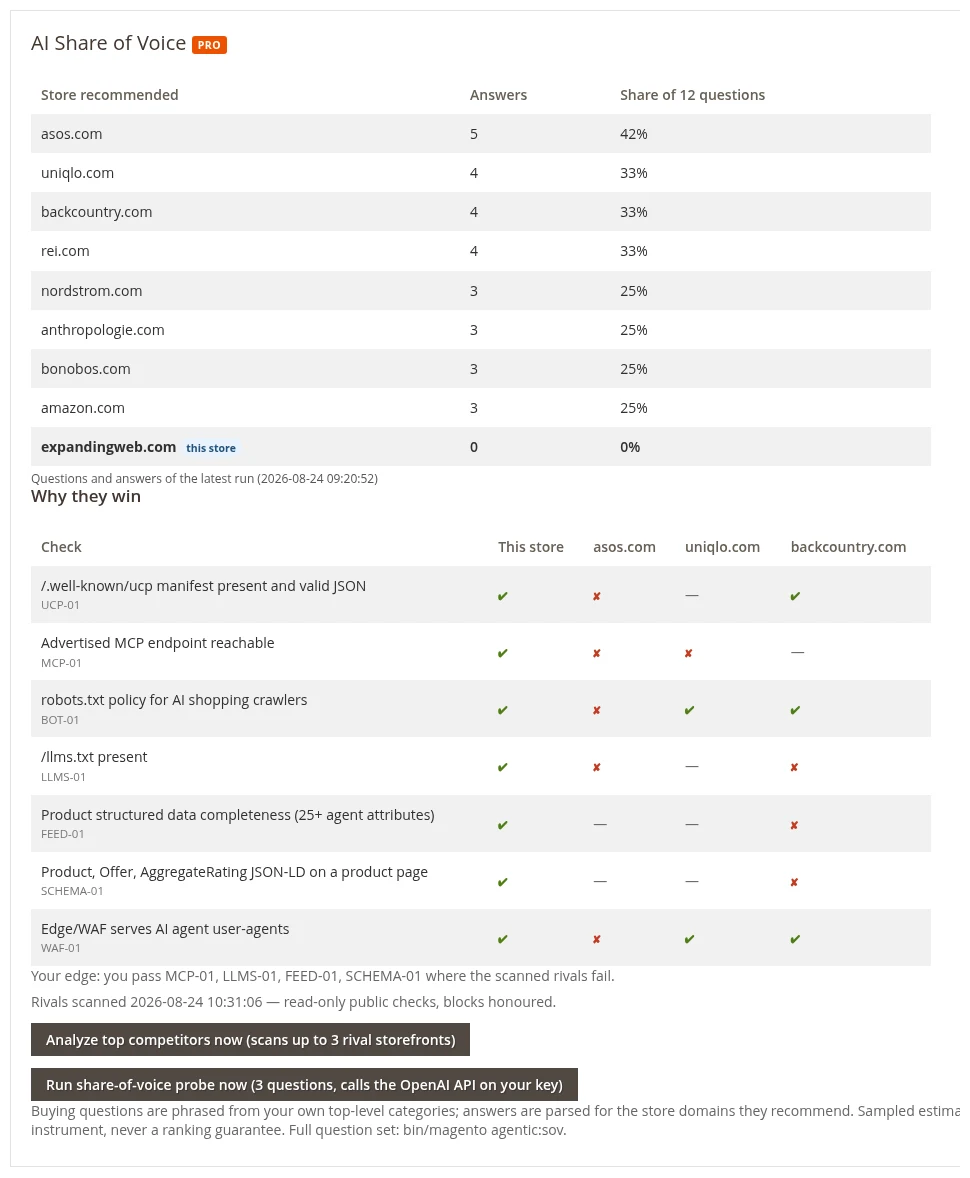
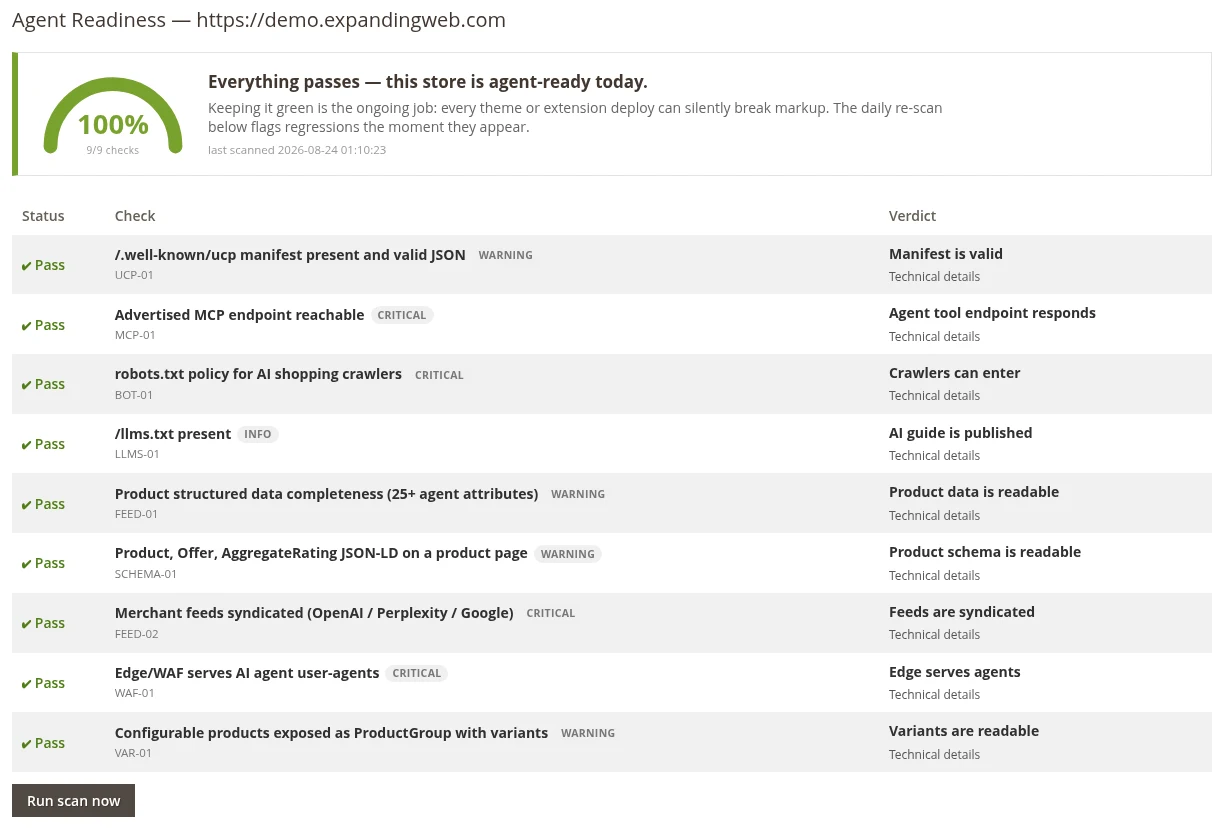
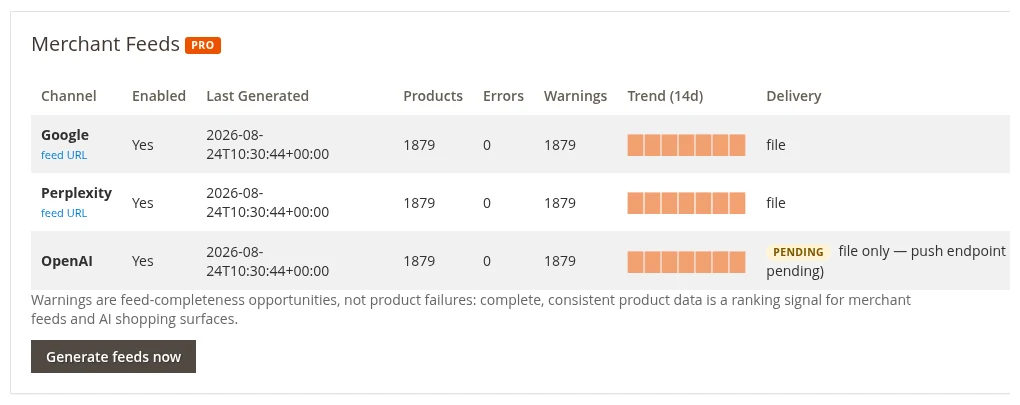
Three screens from the live demo, not a mockup: the panels below are what a merchant sees under Marketing → Agentic Commerce. Open them yourself with the login above.
One module, eleven checks, the fixes behind them
Measure first. Then install what the measurement demands.
The free tier tells you where your store stands with AI agents, from inside your own admin, sending nothing anywhere. Pro installs the operational layer — and keeps scoring it daily, so a theme deploy that silently breaks your markup shows up the next morning.
- SCANFree
Readiness scanner, daily
Eleven agent-readiness checks against your own storefront — UCP manifest conformance, MCP endpoint, robots policy, how your edge answers AI agents, crawl limits on search and facets, llms.txt, product structured data, product schema, feed syndication and variant markup — with score history and a regression alarm.
- TRAFFICFree
Agent traffic analytics
Requests from known AI agents (GPTBot, ClaudeBot, PerplexityBot and the rest of a daily-refreshed list), counted as daily aggregates in your own database, attributed to funnel stages from home to checkout.
- FEEDSPro
Merchant-feed syndication
Your catalog delivered to the channels AI shopping surfaces actually read: Google Merchant Center, the Perplexity Merchant Program and the OpenAI Product Feed — regenerated every 15 minutes, validated, with completeness warnings that double as ranking signals.
- SCHEMAPro
Schema repair
The Product, Offer, ProductGroup, Organization and Breadcrumb JSON-LD most themes are missing, so price, stock and variants stay visible to agents that do not run JavaScript.
- AGENTSPro
Agent endpoints
/llms.txt, a UCP capability manifest, a live JSON product feed, an MCP server with search, product, availability and checkout-session tools, and ACP-style guest checkout sessions where your tax, promotion and inventory rules decide the totals. Order placement is off by default and offline-payment-only when you enable it.
- EXPOSUREPro
Funnel and revenue exposure
Where agent sessions stop, mapped to the failing checks that stop them, and a conservative estimate of the revenue exposed — every input yours to adjust, the method printed next to the number.
- VOICEPro
AI visibility and share of voice
Sampled probes on your own OpenAI key: whether answers mention your store, which stores they recommend instead, and how your share moves between runs.
- RIVALSPro
Competitor analysis
The top stores of your share-of-voice ranking, scanned with the same public checks — the gaps each name the module switch that closes them, and your edges are listed too.
- Version
- 1.4.0
- Platform
- Magento Open Source / Adobe Commerce (incl. Cloud) 2.4.6+
- PHP
- 8.2 – 8.5
- Privacy
- No catalog, order or customer data leaves the store on its own
- Licence
- Verified daily, 14-day grace, degrades to Free — never breaks the storefront
For the team that has to approve it
Your agency has a veto. This is what it will find.
A readiness module that breaks a checkout costs more than every agent it could ever attract. So the code is written to be read, reviewed and patched by the people who own the store.
- Plugins and view models, no core rewrites. Observers, plugins, a router for the agent paths and layout XML — nothing overrides a core class and no core table is modified. The module's own tables are prefixed
expw_agentic_. - Source is readable and unencrypted. No ionCube, no obfuscation, no phoning home from the free tier. What you install is what you can read in your IDE.
- Tested and statically analysed. 127 unit tests covering the scanner, feed validation, licence verdicts, endpoint authorisation, rate limiting and the analytics maths; PHPStan clean; PHPCS on the
Magento2standard with zero errors and a warning budget that only moves down. CI runs all three on every push. - Fails safe by design. The licence check never blocks a storefront request, honours a 14-day grace period when our service is unreachable, and degrades to Free on expiry. Agent order placement is off until you switch it on, and then it is offline-payment-only behind a shared secret and per-IP rate limits.
- Read-only toward the outside world. Every scan — your store's and a competitor's — is a handful of GETs that honours robots.txt and never works around a block. A store that refuses us is reported as refusing us.
Release history
Four releases since 2026-08-15.
We have no customer logos to show you yet — this module is new. What we can show is the pace of work and what changed in each release, dates included.
-
1.4.0 current
- The licence is now perpetual: a lapsed updates year leaves every Pro feature running and only shows a renewal notice. Previously expiry switched Pro off, which matched the annual pricing the module launched with.
- The dashboard names the day updates ended and what renewing buys, instead of quietly changing behaviour.
- The licensing service answers ownership and updates as two separate questions, so only a revocation can take features away.
-
1.3.1
- The scanner now runs eleven checks: the ported public set gained AGENT-01 (does your edge answer AI agents the way it answers a browser) and CRAWL-01 (are search and faceted URLs bounded).
- Fixed: the /.well-known/ucp manifest still used the pre-standard shape after the scanner moved to UCP 2026-04-08, so a store running this module failed its own UCP-01 check. The endpoint and the validator are now built from one profile and a test keeps them in lock-step.
- Checkout capabilities are advertised separately from order placement, so a store that prices a basket but sends the shopper to the storefront no longer claims it can complete a purchase.
-
1.3.0
- Competitor analysis: the top stores of the share-of-voice ranking are scanned with the same public readiness checks, and each gap names the module switch that closes it.
- The dashboard states your edges too — checks you pass where every scanned rival fails.
- A rival that refuses the scanner at its edge is reported as exactly that, never worked around.
-
1.2.0
- AI share of voice: buying questions phrased from your own top-level categories, answers parsed for the store domains they recommend, your own row kept in the ranking even at zero.
- Own-share trend between runs, in percentage points.
- Dashboard link to the public scanner now carries the store domain and failing check ids so the scan starts immediately.
- Fixed: a deprecated default model made every probe answer an error that was reported as an honest-looking zero. Probes now separate an outage from a measurement.
-
1.1.0
- Agent endpoints: /llms.txt, UCP manifest, live agent product feed, MCP server with four tools, ACP-style guest checkout sessions.
- Funnel analytics, revenue-exposure estimate and readiness score history with a regression alarm.
- Merchant feeds for Google Merchant Center, the Perplexity Merchant Program and the OpenAI Product Feed.
-
1.0.0
- First release: in-admin readiness scanner, agent traffic analytics, schema repair.
Plans
Buy it once. Every Magento edition, one price.
Start on Free to see where your store stands. Pro is $399 once per installation — the same for Open Source, Adobe Commerce and Cloud, a year of updates included, and the licence stays yours whether or not you renew.
- Merchant-feed syndication, schema repair, agent-facing endpoints, agent funnel analytics, score history and revenue-exposure estimates.
- AI share of voice: which stores assistants recommend for your own categories — named competitors, your share, the trend — plus a competitor analysis of what the winners publish that you do not.
- No edition surcharge — the same Pro price for Magento Open Source, Adobe Commerce and Adobe Commerce Cloud.
- Multi-store and multi-website setups included; development and staging environments included.
- The licence is yours to keep. When the updates year ends, every Pro feature keeps running — only new versions and support pause until you renew.
- 30-day money-back guarantee.
Instant: Stripe Checkout, then the licence key on screen and in your inbox. Sprint clients get year one free — the key comes with the kickoff. Questions first? support@expandingweb.com.
Updates and support: $199/year per installation, and optional. It buys new versions, compatibility with each new Magento release and our support — never the right to keep running what you already bought. Three years up front: $499. Renew an existing licence →
One price for every edition. The engineering does not get harder because your Adobe Commerce licence is expensive. Comparable extensions charge two to three times the Open Source price for Cloud; here it is the same $399.
Agency discounts: 20% off from 3 Pro licenses; 25% off from 10. The edition does not change the Pro price; license volume does.
Money back: 30 days when you buy from us. A purchase made through the Adobe Commerce Marketplace instead follows Adobe's own 25-day return policy, decided by Adobe rather than by us.
Module questions
The answers a licence decision needs.
Bigger picture — protocols, measurement, whether agent checkout is real yet — is covered in the main FAQ.
Does any of my store data leave my server?
The free tier makes no outbound calls except the daily self-scan against your own storefront URL. Pro features call exactly the services you enable: merchant feeds are delivered to the channels you enrolled in, the AI visibility and share-of-voice probes call the OpenAI API on your own key, the competitor analysis reads public documents of the rival stores, and the licence check sends your licence key, storefront domain and module version — never catalog, order or customer data.
What happens when the year of updates ends?
Nothing switches off. The licence is perpetual: you bought the module, and every Pro feature keeps running. What ends is the entitlement to new versions, to compatibility work for each new Magento release, and to our support — renewing at $199 a year resumes all three. The module says so in the dashboard on the day it happens rather than quietly changing behaviour. A licence returns to the free tier only if it is revoked: a refund, a chargeback, or the same key presented by a second storefront.
Do you promise placement in ChatGPT, Perplexity or Google AI answers?
No, and we put that in writing on every surface of the module. Assistant answers are non-deterministic and enrolment, discovery and ranking remain controlled by the platforms. What the module gives you is measurement — sampled visibility and share-of-voice runs with named competitors — and the infrastructure work that is in your control: feeds, structured data, agent endpoints and bot policy.
Which Magento editions and versions are supported?
Magento Open Source and Adobe Commerce (including Cloud), version 2.4.6 or newer, PHP 8.2–8.5. One Pro price for every edition; multi-store and multi-website setups plus development and staging environments are included in a single installation licence.
What do the AI probes cost to run?
They run on your own OpenAI API key, so you control the spend and we never see the key or the answers. A full share-of-voice run asks up to 12 buying questions; a visibility run asks 6 prompts. Both are monthly at most (the cron is off by default) with 3-question samples from dashboard buttons.
Can AI agents place real orders through the module?
Only if you switch it on — order placement is off by default. When enabled, agent checkout sessions are ordinary Magento guest quotes, so your tax, promotion, inventory and shipping rules decide the totals, orders are placed with an offline payment method you nominate, writes require a shared secret, and per-IP rate limits apply. An agent cannot present card credentials, and the module will not pretend otherwise.
How do I buy Pro, and what does it cost?
$399 once, per Magento installation, with a year of updates and support included — the same price for Magento Open Source, Adobe Commerce and Adobe Commerce Cloud, with multi-store, multi-website, development and staging environments covered by that one licence. Updates and support continue for $199 a year afterwards, or $499 for three years up front, and both are optional. Agencies pay 20% less from three licences and 25% less from ten. At launch, licences are issued through the readiness-review form or support@expandingweb.com — send your Magento edition, installation count and store URL. 30-day money-back guarantee.
Something not answered here?
Nina · Expanding Web AI assistant
Hi, I'm Nina, Expanding Web's AI assistant. Ask about scope, protocols, pricing or the process — or call (+1) 415 802 1072 any time, or (+48) 693 868 369 during European hours.